Big apologies to all for disappearing on you, except for the very occasional tweet. The bottom line is that one of my kids recently had major surgery...one that required a week in the hospital and a painful recovery that is still underway at home. He's doing well and getting better on a daily basis. Spring break has given him extra recovery time without missing more school, but we've also had a lot of family visiting (he's loving the attention ;). Needless to say, I've had to put a lot of things aside in order to focus on the family front. And I'm exhausted.
I am, however, slowly re-surfacing :). I have a post up at Revising & Editing on 'A Writer's Hindsight and the Secret that Sold' (thank you, Nas Dean of Romance Book Haven, for the blog tour!). Plus, author Kate James interviewed me recently and you can check it out HERE.
On the chicken front...they're growing really, really fast! I ended up with 18. Yes, they're addictive. With everything that has been going on, we're behind on coop building, but it is happening (because it has to ;). I'll post pics when it's done.
I've missed you all! :)
Showing posts with label writing. Show all posts
Showing posts with label writing. Show all posts
Friday, April 18, 2014

Monday, February 3, 2014
Interview with Author J.L. Campbell

Rula: It's such a thrill to have you here, Joy. You're holiday novella, Anya's Wish,
was a prequel to Chasing Anya, book 1 in your romantic Island Adventure Series. Once again, in this series as with
your other books, you transport readers to Jamaica, but what's fascinating is
that in each genre you write--whether middle grade, romance or adventure--we
get to experience a completely different side of Jamaican society, including
economic status and lifestyle. Which, if any, did you find to be the most
rewarding to write and share with readers?

Joy: Thanks for
having me, Rula. It’s a pleasure to be here. One of the good things about being
a writer is that I get to share my island home with the world. Jamaica is a
character in each story, which allows me to give readers an inside view. I think
readers get an unspoiled and wondrous view through the eyes of a child and the
middle-grade series has allowed me to do that.
Rula: Absolutely. I'm a huge
fan of your middle grade Simms Siblings series. Both Christine's Odyssey and
Saving Sam were poignant stories that had me by the heart. I fought tears in
every chapter and every page made me want to go give my own children hugs. The
setting was vibrant and beautifully authentic, the psychology of the child
characters heart wrenching and real...and the writing style deliciously skilled
and organic. What was writing from the perspective of a traumatized child like
and what, if any, research has gone into these books?
Joy: Christine’s Odyssey was the first novel I wrote and it
took a nine-year route to publication. As I've grown as a writer, my stories
have evolved. That novel came out of a conversation I had with a friend whose
brother had died and she was given care of his daughter. My mind went into
‘what if’ mode and the story grew from there. My research came at the back end,
in that after I’d written the story, I contacted a guidance counselor, lawyer,
police officer, doctor and social worker. These conversations, along with research,
took care of fact checking and getting accurate information on things such as physical
injuries to the local legal system.

Rula: I really
enjoyed the blog posts you've done introducing various Jamaican foods and
facts. From the boiled green bananas in Christine's Odyssey to the fried
plantain chips Anya snacks on, to all the tropical ice cream the Simms siblings
savor on hot Jamaican days...it all makes me hungry. What's your favorite
Jamaican dish and is there a particular snack you reach for when writing?
Joy: The national
dish Ackee & Saltfish (cod fish) with fried dumplings hits the spot for m every
time. If I have to eat when I’m writing, I like banana chips. They’re made from
sliced green bananas.
Rula: Mmm. You're making me hungry. I've been
following your journey as an Indie author for awhile and I'm so impressed with
how prolific you are. The writing experiences you've shared on your blog, The
Character Depot, have been inspiring and invaluable. How have you managed to
find that illusive balance between promotion, social media, magazine articles,
family and actual writing time?
Joy: Rula, much
to my distress, I haven’t really found a balance, but writing things down helps
tremendously. I've come to realize that there will never be enough time to do
all that’s required, especially since I decided to self publish. Since I don’t
make enough time for social media interaction, I take advantage of author
sponsored group promotions.
Something
else that has helped me is that before I was published, I had more than six
stories already written. This meant that when I was eventually published, I was
adding more books to those I had already written. This is one of the best forms
of promotion a writer can utilize. In looking at my books on Amazon, I can tell
that people who read them tend to buy others that I've written.
I've accepted the fact that I’ll also never have enough time to write, so I've learned to make the most of those periods when my stories are flowing. My
family is supportive, which makes this journey a lot easier.
Rula: Is there anything you would have done differently along the way or any tips (or warnings) you have for writers considering Indie publishing (or publishing in general)?

Rula: Is there anything you would have done differently along the way or any tips (or warnings) you have for writers considering Indie publishing (or publishing in general)?
Joy: I’d just
caution writers to study the business of publishing before jumping off. I was
caught flat-footed when I was first published because I didn't understand that
I was expected to do a huge chunk of marketing. There is so much information
online that there’s no excuse not to know what’s happening in publishing today.
Alex Cavanaugh’s brainchild, the Insecure Writer’s Support Group, is an excellent starting point for
anyone who wants to make their writing a business. It also serves the needs of
anybody who wants to know what’s new in the world of publishing.
My best
piece of advice is to study the craft of writing. There’s nothing better that a
writer can do to improve his/her skills. Just like anything else we’re serious
about, we all have to put in a period of apprenticeship.
Rula: March
will bring the release of Taming Celeste, book 2 in your Island Adventure
Series, and readers are also looking forward to the third book in your Simms
Sibling series. It's going to be a busy year for you! Can you give readers a
hint at what they'll find in these two books?

In For Love of Cass & Jamie, the girls come under threat when their adoptive parents face trouble in their marriage. The sisters deal with their problems in different ways and sadly, one of them becomes bulimic. All I’ll say is that they’re kids and deserve a happy ending.
Rula: I can't wait for those releases. Books are
a formidable way to raise awareness and battle ignorance. This is in part
because books are a universal transport system. Anywhere you want to go. Any
adventure, culture or way of life you want to experience. Books connect people
in so many ways. You've done a brilliant job bringing Jamaica to life for those
who haven't been able to visit (it's one of my dream destinations...one of
these days!). If you could hop on a plane right now (no deadlines to worry
about ;) and visit any place on earth, where would you go? Was this choice
inspired by a book you read? :)
Joy: I agree with you
there, Rula. I've been to many places complements of books. I’d love to visit
Egypt and incidentally, some of my fascination with that land was inspired by
Mark Twain’s adventures.
Rula: It has been great having you here! Thanks for hanging out with us today!
BLURB: Chasing Anya (w/a Jayda McTyson)
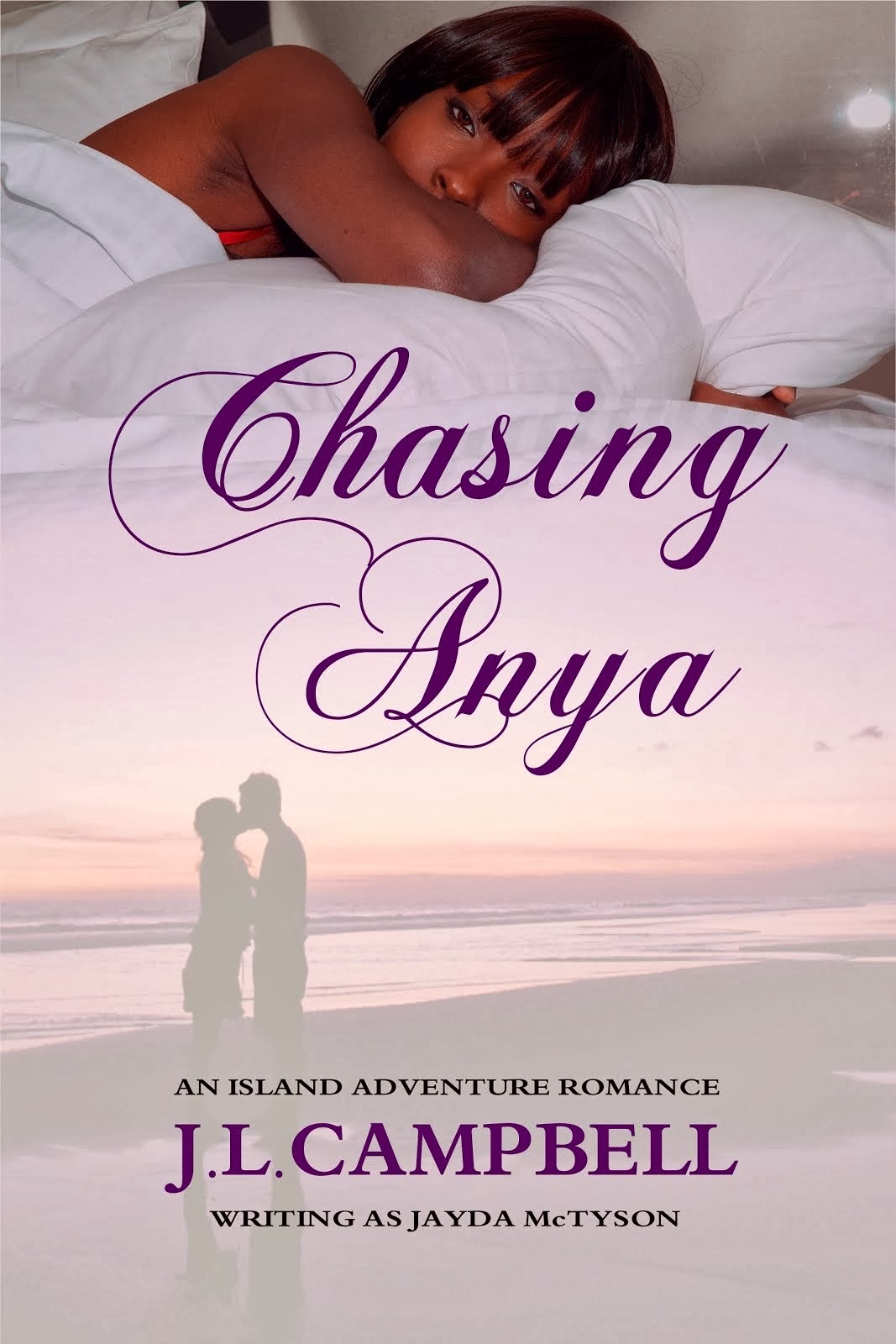 Been there. Done that.
Feisty and independent, Anya Davies lives by her own rules. The one thing she's hell-bent on avoiding is a conventional relationship, thanks to her abusive ex who refuses to stay in the past. As far as she's concerned, romance is a no-no.
The second complication in her life is a secret that condemns her to constant guilt and a solitary life. A series of near misses and escalating threats are a third and worrying factor. Only a special man would understand or live with Anya's challenges and demands.
Casual sex...so not having that.
Enter Christophe Mondesir. Two years ago, Anya dumped him without explanation. An accidental meeting shoots Anya back on Christophe's radar. He refuses to be denied and plans to breach the fortress Anya has built around her heart--if she'll commit to more than a casual liaison. He's also determined to find out what she's hiding. That's if the stalker who's after Anya doesn't end her life first.
BUY IT: Amazon
FIND OUT MORE ON JOY'S AWARD WINNING SIMMS SIBLINGS SERIES: (w/a J.L. Campbell)
Christine's Odyssey (Book 1)
Saving Sam (Book 2)
Jamaican Kid Lit blog
HANG OUT WITH J.L. CAMPBELL:
Friday, October 11, 2013
Senior Editor Victoria Curran is at Romance University!
We're closing in on Halloween and do I have a sweet treat for you! Victoria Curran, Senior Editor for Harlequin Heartwarming, is over at Romance University talking about conflict and raising stakes in clean romance. Check out her post titled Fifty Shades of Sweet. She makes excellent points, explains in a way that clicks and gives examples of critique comments she has given in the past. It's truly a must read for any writer, regardless of genre.
Also, a heads up, I'm working on a website and plan to make this blog match...so if you pop by here in the near future and things look different, don't worry, you're in the right place :).
Monday is Columbus Day in the US and Thanksgiving Day for my Canadian friends, so Happy Friday, Happy Thanksgiving and have a great long-weekend!
Tuesday, June 25, 2013
Post-call Tip #1
I know many of you have already been through the publishing process and know the ropes, and others are where I was just a few weeks ago, waiting on submission responses and dreaming of the call, but I thought it would be helpful either way, to share specific tips as I experience the post-call journey to that first book release. As for non-writing readers out there, you may enjoy the glimpses of what goes on behind the scenes with authors.
My first tip revolves around Art Fact Sheets (AFS), the infamous, detailed questionnaire completed by authors and used by publishers to plan everything from cover art to book blurbs. I had to fill mine out shortly after The Call. I won't get into every aspect of the AFS, but there is one tip that, had I known, would have saved me tons of time. Pictures.
Now, I had read plenty of blog posts about writers using picture collages in their office as inspiration for their books. Some even used Pinterest or other online photo share sites to collect pictures of models or actors that 'looked' like their hero or heroine, photos reminiscent of their setting etc... What I picked up from what I read (and of course I may have missed something) was that the purpose of these collections was inspiration. Well, I'm very visual, and I do search the internet during my research phase for pictures that jog my muse, but I've never saved them. I kept them in my head. My mind's eye is so vivid, I saw no need for cork boards or the internet equivalent. Unfortunately, when it came to completing my first AFS in less than 24 hours and on 3 hrs of sleep, I couldn't download my brain to my computer.
I ended up spending several hours scouring the internet for those images in my head, or similar ones, so that I could copy the links to my AFS. I desperately wanted to be sure the art department could 'see' what was in my head when they came to designing my book cover. The entire time I scanned the internet, I wished that I had kept a file, dedicated to the book, that had photos or photo links organized by hero, heroine, setting etc...so that I could have simply uploaded it to the AFS form.
So my tip of the day...those picture collections are not just for inspiration. You're going to need them, and not simply tacked on a cork board in your office. Keep a file, on your computer or on a share type site, label it for a specific book, and keep it updated as you write. I'll be doing that from now on. It'll save you a lot of time and stress when AFS time comes around.
Monday, September 3, 2012
Labor Day, Laughs and Liz
Happy Labor Day!
My Labor Day treat for you is a must-see link that will leave you laughing. Check out Nathan Bransford's visual take on the emotional stages of writing a book. He calls it The Publishing Process in GIF Form, and trust me, both readers and writers will get a kick out of it. Make sure you scroll through to the end! It's accurate, funny and a bit nostalgic. You'll see what I mean :)
Also, my debut as a USA Today Happy Ever After blog contributor is scheduled to post this Wednesday, September 5th at 3 pm! Since I don't post here on Wednesdays, I'm giving you the heads up...and I'll slip in behind the scenes to add the exact link (it should work at 3pm). I'll be interviewing Harlequin Superromance author Liz Talley on her new book, The Road to Bayou Bridge. Pop by if you get the chance!
Now, go start your day with a good laugh at Nathan's publishing process :)
Take care and have a great one.
Monday, June 18, 2012
What would you do?
Seriously. What would you do if faced with a moral, ethical or otherwise emotional dilemma? How would you react in a crisis? Would you step out of your comfort zone or interrupt your hectic schedule to come to the aid of a complete stranger? An individual's reaction in situations like these shows their true character. It separates courageous heroes and heroines from...well, from others.
I'm not going to come down on anyone. There are many reasons why a person might not come to the aid of another. Perhaps the situation is dangerous. Perhaps they're afraid it's a criminal set up...one person distracts and another comes in for the steal. It happens. That's why those who do come to the rescue are courageous. But what if there isn't any imminent danger? Take, for example, the situations John Quinones of ABC News sets up in his Primetime show 'What would you do?'. Check out the link if you haven't seen the show before. I love watching it with my kids (yes, I'm hoping they'll learn that it's good to stand up for what's right).
These aren't simple situations. Each one involves a dilemma where actors set up a 'situation' and hidden cameras (and John Quinones) capture who walks by and who steps up to the plate. I've seen episodes that involved students cheating, non-disabled individuals parking in a handicapped space and refusing to move for a person in need, a man at the beach telling his wife she's fat and should cover up etc... In fact, they even flipped the scenario in that one to see how strangers would react if the wife said abusive things to the husband. Funny how people react differently depending on if women or men are the victims. John doesn't take it easy on folks. He ups the ante in each situation. It's an excellent show to watch if you're interested in human behavior. What writer isn't? The folks who step in, take action and do what's right are heroes and heroines. The show is full of inspiration for the types of characters we like to read and/or write about. I personally love stories/movies where the hero ends up being the shy/insecure guy who no one would expect bravery from. Neville Longbottom in Harry Potter comes to mind :)
So have you been faced with a moral dilemma that you'd like to share? Maybe there's one you witnessed or where you were the victim? What happened and who stepped in to help?
Monday, May 7, 2012
My latest craft book must have!
Cliches have met their match!
The Virgin Widow's Heart Stopped When She Saw the Book That Would Change Her Life Forever by Ellen Hartman and Sophie Gunn just released on Amazon (Kindle) last week, and I promise it really will change your life. Well, okay, your writing life, although it could inspire people everywhere to discover their individuality and revamp their social skills :). I mean, who likes a cliched pick-up line. Right? Seriously though, I rank this book up there with Debra Dixon's famous Goal, Motivation, and Conflict as a staple for all writers.
The book is based on Ellen and Sophie's popular workshop, which I attended at last year's RWA Nationals meeting. The room was packed with not only published and unpublished writers, but editors as well. You know the workshop where everyone laughs, takes notes like crazy, then they push and shove to get to the speakers and ask more questions at the end? Alright. Romance writers are more civilized than that, but yes, it's that great and this is your chance to find out their anti-cliche secrets, as well as their fail-proof way on how to find your voice. Whew, that was a long sentence! It's because my heart's racing with excitement! (Okay, that was bad ;)
This isn't just about killing cliched phrases. It's about fixing cliched characters, plots, situations, and even promo. I hate it when people point out problems but don't provide solutions. This book tells you how to un-cliche a cliche. It's full of examples and step by step approaches to making your writing unique. It's a fast-paced, funny read loaded with a phenomenal amount of information. Definitely a craft reference must have.
Buy it or find out more on Amazon.
Note: I'm aware that the word cliche has an accent, but I couldn't figure out how to make it happen. Let's just pretend that I'm wildly clever, and I left it off to symbolize ripping apart cliches :)
Monday, January 9, 2012
Word association
Our subconcious mind is a mighty thing. It can both empower and weaken any individual. In my opinion, it's at least partially responsible for luring even the strongest, most experienced writers into the dark world of 'clichedom' (let your mind add the accent). It can also make the difference between an individual gravitating towards a certain book title...or not. Think about it (or not). Our subconcious mind rules word association.
The idea behind getting the first draft of a manuscript out of your head and into print is to write without self-editing. Let the words flow. Get the story out...and revise it later. Well, when you write the first thing that comes to mind, it often includes a cliche. We've heard certain expressions, analogies, and actions so often that they're the first thing our mind goes for when we're trying to grasp for 'the right words'. Hence, the need to tackle the 'twist' during revisions.
What about book titles? Are there any words that turn you away because they have a negative association for you? I don't know the process publishers go through to choose book titles, but what do you want to bet that they've run stats on which key words sell? Which key words a reader associates with the feeling/experience they want to get out of a book? Subconcious marketing...a mighty thing ;).
So how about some fun with all this? You know the game. I say (list) a word and you have to respond with the very first word that pops in your head (keep in mind that I don't have content warnings on this site ;). I'm interested in seeing if the ten words I've listed result in similar responses for those of you who are writers, and perhaps different responses for those who are (non-writer) readers. Note: I've included some prefixes. Here it goes...
Dark
French
The
Pro-
Para-
Complete
Self
Free
Fire
Hand
After listing your first responses, give yourself a minute to think. Did any of your word association answers change?
Monday, January 2, 2012
Happy New Year!
May 2012 bring all of you the best in books, publishing, writing and reading.
I'm a 'list' person, but if I make vague resolution lists I'll end up jinxing my goals. It's like saying you're going to start a diet. It never lasts. I make 'To Do' lists throughout the year...both for writing and household/family activities...but they're very specific, concrete things that need to be accomplished. Each task is a step towards fulfilling a larger goal...kind of like word counts.
One of the smaller steps I take towards becoming a better writer (and eventually a published one ;) is to read craft books. I know not everyone likes to read craft books, but I'm a huge fan. I agree that simply reading a craft book doesn't make a person a great writer, but I do think that the information eventually embeds itself deep enough in one's mind that the benefits and changes will come through in their writing. It's a solid step towards a larger goal.
My favorite craft books are listed in the left margin, and I believe I once pointed out how much I loved James Scott Bell's Plot and Structure. Well, the first craft book I'll be reading in 2012 is his latest called Elements of Fiction Writing - Conflict and Suspense. I want lots of great conflict in 2012, but only in stories LOL!
I've also heard tons of good things about Scrivener (for PC in my case). I'm as much of a note card girl as I am a list girl. Sticky notes count too, but I can't live (or write effectively) without my 4X6 lined note cards. I use them for everything, including one for each beat on Blake Snyder's 'Beat Sheet' from Save the Cat. I don't know how I ever wrote without you, Blake. Back on track....check out the link for Scrivener. The pictures are amazing and it looks like any note card/OCD girl's dream to organizing, plotting, and revising a manuscript. I'm not a natural at computer programs, but I do love efficiency. I'm dying to dabble with this and see if I can use it for my next manuscript.
So have any of you used Scrivener? Are there any new craft books you're planning to read in 2012? What concrete steps are you taking towards larger goals (writing or otherwise)?
Monday, October 17, 2011
Craft Quotes
I was looking over my calendar yesterday and it hit me...2011 is in the home stretch. That realization always puts a little fire under me. It ups the pressure on making sure I've accomplished my writing (and other) goals for the year. One of the things I did this year was read through recommended books on writing. Books that spanned revision to plot to conflict and more. I believe all people are perpetual students of something. We're in a constant state of learning through study or through experience. For me, this year was about pushing my writing skills.
I have most of the writing/craft books on my shelf listed in the side bar. I read them with a highlighter in hand and recently went back through to see what I'd marked. I thought I'd share a few quotes I found to be important.
"Make sure the GMC's of multiple characters collide. The collision creates conflict." Debra Dixon - GMC: Goal, Motivation & Conflict
"Pressure is essential. Choices made when nothing is at risk mean little." Robert McKee - Story
"...if the inciting incident presents a problem that compels the protagonist to defend herself, rather than propels her toward achieving a goal, the story produces a reactive hero, not a proactive hero." Elizabeth Lyons - Manuscript Makeover
"Complex and too complicated are two different things. Complex is interesting; if shows writer finesse and control. Complicated is a chore." Elizabeth Lyons - Manuscript Makeover
"Motive is what gives moral value to a character's acts. What a character does, no matter how awful or how good, is never morally absolute... A character is what he does, yes - but even more, a character is what he means to do." Orson Scott Card - Characters & Viewpoints
There are so many more fabulous quotes from the books I've read, but too little time. One can read, and read, but at some point they have to go off and apply what they've learned ;). Hence, I need to go tackle more revisions. I highly recommend the books in the side bar for anyone in need of some craft inspiration and direction.
I hope you all have a productive week and get all your yearly goals accomplished in the next 2 1/2 months! Feel free to share any favorite craft quotes or books :)
Monday, September 19, 2011
Reader-Writer Relationships
I think we can all agree that the internet has drastically changed the way people connect. Whether it's for business, advertising, dating, educating, chatting or skyping, most of us rely on daily internet access as a means of reaching out to others. Needless to say, internet communication has had an enormous impact on reader-writer relationships.
We've gone from fan letters, to fan emails, to friendships. Sure there are still strictly writer-fan relationships out there, but I really think that chatrooms, facebook, twitter, and forums have allowed readers and writers to get to know one another better. The frequency of communication, as well as the back and forth nature of it, has allowed for, what I'd call, friendships to form. A true connection. I'm still working hard towards getting published in fiction, but I'm an avid reader as well as a writer (and I have many published friends). My opinion stems from both perspectives.
Now for confessions. In spite of pressures/advice from the publishing world to FB, Tweet, blog and more...I'm just a blogger. That alone was a huge step for me. However, I do love participating in writer/reader forums (such as eharlequin's) and have formed wonderful friendships that way. Once published, I have no doubt I'll need to expand my internet communication routes.
So for all you readers out there (and this should include writers by definition), what's your favorite way to connect? What fits your routine the best? How much of your time do you spend reading blogs vs tweeting vs checking out author websites or facebook pages? Which do you think nurtures the best reader-writer relationships?
Monday, July 11, 2011
Raising Writers
A few days ago, I shared a park bench with a lovely grandmother of twins. As we hawked over the archery camp in progress (first timer here, and the idea of a bunch of kids with a bunch of bows and arrows had me a tad worried), our conversation turned to child education and keeping their minds working over the summer months. To my surprise, the grandmother told me she was in absolute love with her iPad.
I skirted the fact that I don't own a basic ereader...let alone an iPad. I know. I know. Pathetic.
She went on to mention that she convinced her grandkids to keep journals over the summer by showing them a journal app she'd discovered (I can't recall what tech gadget the kids were working with). Man! Am I THAT old? How many of you, as kids, wrote journals with pen and paper? Mine even had a cheap, little lock on it. Talk about a false sense of security, LOL. Nothing compared to the fear of internet info leaks though.
My older son overheard the conversation and, once we were in the car, proceeded to 'inform' me of how that grandmother was WAY cool and knew WAY more than I did about iPads, even though she was WAY older than me (his words). Yep. He wants an iPad.
He tried using age and humiliation to milk it.
But I'm a mother...heh...heh. A master in the art of milking it right back. Two words.
Eductational apps.
Plus, in my world, you want it? You earn the money for it.
So where does raising writers come in to all this? Well, apps that encourage kids to keep journals is one way. I'm no expert at apps, obviously, but I did come across a few interesting sites that review writing related apps for kids. Bestappsforkids is one site. The link takes you to a few writing apps, but if you explore the site, you'll find other educational apps, including some for math. There's one in particular called Shake-a-Phrase that is geared for ages 6 and up. Again, I haven't tried any of them, but they look like good options.
I also found a writing pad on itunes. This, I believe, is an actual lined pad on which kids can physically write.
For now, my kids have traditional workbooks (they do have a few educational CDs for the computer too). If they finish a workbook by the end of the summer, I pay them. Hey, it is called a 'work' book. If adults get paid to work, what's wrong with kids earning money by working hard? If they are willing to practice math, or keep a journal, or write reports on several summer reading books, why not reward them? What unpublished writer wouldn't love to get paid for their writing?
My kids also take music lessons. These early years are the critical time when everything a child is exposed to influences how the brain's wiring develops. I'm a strong believer that learning to read and play music strengthens a child's ability to learn, not only math, but language (reading and writing) skills.
We also take regular visits to a regular library (not an online bookstore). I want my kids to remember what it's like to smell, see, and touch hundreds of books. I know libraries won't disappear, but they'll change. My kids can't believe we had index card catalogues when I was a kid. The grandmother on the bench told me she had no doubt that pretty soon every child in a classroom would have an iPad (or similar gadget), and all textbooks, homework etc...would be done on it. That would certainly make for lighter backpacks!
This is such a complex topic and I've struggled not to go off on tangents, but the bottom line is that writing is a critical skill regardless of what profession you enter. With the technology and gaming boom coming at our kids from all directions, how do we make sure our kids don't go brain dead over the summer months? How do we ensure that the language centers in their brains get properly developed? There's no doubt that the wiring that occurs as a result of hands to paper writing vs keyboard writing differs. What do you think about all this. Do you involve your kids in summer activities that encourage their reading and writing skills?
Monday, June 20, 2011
Laugh break
I can't believe RWA Nationals is only a week away! I have yet to pack, but I'm making a good dent in house cleaning. I know...why clean up if I'm leaving behind three kids, a husband, and a dog? Like I'll be coming home to a clean place. Right. Anyway, for all of you in need of a laugh break, I came across a few writing jokes. I have no idea who wrote them, but I found them at this site by Karyn Hollis at villanova edu. I hope they jump start your week with a smile :).
A writer died and was given the option of going to heaven or hell.
She decided to check out each place first. As the writer descended into the fiery pits, she saw row upon row of writers chained to their desks in a steaming sweatshop. As they worked, they were repeatedly whipped with thorny lashes.
"Oh my," said the writer. "Let me see heaven now."
A few moments later, as she ascended into heaven, she saw rows of writers, chained to their desks in a steaming sweatshop. As they worked, they, too, were whipped with thorny lashes.
"Wait a minute," said the writer. "This is just as bad as hell!"
"Oh no, it's not," replied an unseen voice. "Here, your work gets published."
A screenwriter comes home to a burned down house. His sobbing and slightly-singed wife is standing outside.
“What happened, honey?” the man asks.
“Oh, John, it was terrible,” she weeps. “I was cooking, the phone rang. It was your agent. Because I was on the phone, I didn’t notice the stove was on fire. It went up in second. Everything is gone. I nearly didn’t make it out of the house. Poor Fluffy is--”
“Wait, wait. Back up a minute,” The man says. “My agent called?”
Ode to the Spell Check
Eye halve a spelling chequer
It cam with my pea sea
It plainly marques four my revue
Miss steaks eye kin knot sea.
Eye strike a key and type a word
And weight four it two say
Weather eye am wrong oar write
It shows me strait a weigh.
As soon as a mist ache is maid
It nose bee fore two long
And eye can put the error rite
Its rare lea ever wrong.
Eye have run this poem threw it
I am shore your pleased two no
Its letter perfect awl the weigh
My chequer tolled me sew!
Monday, June 13, 2011
Interview with Harlequin Superromance Author Ellen Hartman

1. No conflict. No story. In 2008, you gave an online workshop on conflict called Making a Minefield. For those of you who haven't read it, click on the link. It's an absolute must-read, and it contains really great examples. Any new gems or brainstorming techniques on how to keep conflict fresh?
I had such a good time on that workshop. One of the techniques I used successfully in both of my most recent books (Calling the Shots and Married by June) is to swap the gender of characters.
In Calling the Shots, my original plan was for the hero's son (a hockey star) to bully the heroine's daughter (a not-so-good hockey player). It seemed trite for the jock stud to be a bully, and it was hard to make the hero or his son likable. Then I swapped the bully's gender. In the final book, the hero's daughter (a star hockey player) bullies (sort of) the heroine's son (a not-so-good hockey player). This kept the conflict fresh--a girl bullying a boy is less common. It set up some delicious conflict for the heroine and her son. She wants to protect him and shelter him and he wants her to back off! I found it much easier to write the hero as a sympathetic character when he was struggling to understand his daughter (who was stressed out, but not malicious), than when he was defending a jerk of a son.
I had similar success when I changed the gender of a character in Married by June, but if I explain it will spoil part of the plot!
I think in general, a great way to increase conflict is to write solid characters. Conflict works best when it's specific and memorable. Any time you move your characters away from the norm or the trite and find the "real" you're going to have a better story.
2. In 2009, you and fellow Superromance author, Jeannie Watt, did an incredible eharlequin discussion called Shopping for the Alpha and Beta Hero. Gamma guys make an 'appearance' too, and authors from several different Harlequin lines chimed in. It's another must read, and I just have to ask...any chance you'll ever write (or co-author) a craft book on writing?
Thank you so much. I'm thrilled those workshops are useful! I love Jeannie's writing so I was pumped to get to work with her. I don't think a craft book is in my immediate future, but I love doing workshops.
If anyone is attending the RWA conference in NYC, my critique partner, Diana Holquist (she also writes as Sophie Gunn), and I are giving our workshop, "The Virgin Widow's Heart Stopped When She Saw the Workshop that Would Change Her Life Forever: Working with and against Cliches to Make Your Work Shine...And Sell!" (How about that title?) We do some overview and then jump right into examples from our work to show how we edit to get the absolute best stuff we can. We also do live critiquing with work from audience members. I'd love to see folks there. (It's Thursday afternoon from 2-3.)
I also offer a workshop on Beta heroes and one that's drawn from my day job as a technical writer on how to usability test your author web site or social media portfolio. I'm hoping to have the chance to do workshops more often.
3. Getting The Call is up there with marriage proposals as one of life's sweetest moments. We'd love hear about when your editor proposed to you...okay, okay...you know what I mean. Your latest release, Married By June, has marriage on my mind ;). Tell us your Call story!
When my son was in kindergarten he was obsessed with guns. He met a kid named Hunter and assumed the boy must have access to weaponry. (Duh, why else would someone be named Hunter?) My son demanded that I invite his new found best friend for a play date. It turned out that Hunter did not have guns, what he did have, is an amazing mother. Leslie Daniels was a literary agent and is my most precious friend here in Ithaca.
A few years later, I won the Great Expectations contest, sponsored by the North Texas RWA, and the prize was a partial read by Laura Shin, from Superromance. She requested my full manuscript. I sent it in and then there was quite a lag before I eventually got a 5-page revise and resubmit letter. So I took my book apart and put it back together and sent it off again. At that point, I was pretty sure I was going to get an offer. I knew NOTHING about publishing or I'd have known how often things get to that stage and still don't go to contract, but I was uneducated. I knew you didn't need an agent to sell to Harlequin, but I'm painfully shy and 100% incapable of negotiating around money so I really wanted an agent. Leslie kindly wrote letters of introduction to several famous literary agents and I sent them my book. They turned me down flat, every one. Leslie didn't represent any romance clients, but she took pity on me and said she'd be my agent. Thank goodness.
So I was all set with my agent and all I needed was the Call. I was at work in my cubicle in the Cornell vet school one day when Leslie called. She said, "Laura Shin left a message while I was out. She said she's going to call back this afternoon."
I said, "I hope she's not calling to reject it." (Honest to God, this is what's inside my brain!)
Leslie: "They don't call to reject things."
Me: "It could be a new policy."
At that point Leslie asked me to try not to let on that I'm crazy when I was talking to Laura. The actual call from Laura is a blur. I remember where I was...sitting on a bench in the atrium of the vet school building, but not what we said. I only remember that conversation with Leslie, because that's when it all started to seem real!

Two things: I finished a book and I submitted it. I had this conversation with my critique partner, Diana, shortly after she got her first contract.
Me: "I'm never going to sell a book. I think I should quit."
Diana: "Have you submitted your book, yet?"
Me: "..."
You can't sell it if you don't finish it and send it in.
5. You have a degree in creative writing and create wonderful romances by night. However, you're a technical writer by day and a self-professed lover of logic. Are you more left-brained, right-brained or is it a tie? When you come home from work and get ready to write romance, is the transition in writing style easy or difficult? In what way does your love of logic and your technical writing mindset influence/affect how you tackle a character's emotional arc?
The writing style thing is easy. Practically the only thing I'm confident of in my writing is my voice so I can settle into fiction no problem.
The left brain/right brain thing is complicated. I'm a combination, but my right-brain tendencies scare me so I subdue them with left-brain stuff. For example, left-brain people like to make lists. I don't like lists, but not having one feels dangerous. So I make very high-level lists. Or I make them in the middle of the night when I'm nervous and then never look at them again. Left-brain people read magazines in sequential order while right-brain folks dip into the interesting stuff and skip around. When I read The New Yorker, I read the movie review (the last page) first. Then to punish myself for skipping to the good stuff, I force myself to read sequentially backward.
The logical issue is the hardest one. I am logical. I like logical, sensible people. But I'm writing books about people who make decisions that go against their best interests. The key thing for a romance conflict is that if one person gets their heart's desire, the other person loses theirs. This always bogs me down when I'm writing. I can't move forward unless I know why a character will chose a particular path. In Married by June, the heroine, Jorie, gets engaged even though she knows she's not in love. I didn't intend to show the engagement in the book, partly because I couldn't figure out what she was thinking when she made that decision. Then my editor and all of my critique partners asked to see the engagement. I wrote it mostly as a character exercise, but I loved the way it came out. It convinced me that Jorie's decision made sense, so that scene is now the prologue for the book.

This question made me blush. Thank you so much. One of the reasons I love being edited by Victoria is that she has a great eye. She encourages me to develop scenes when she knows they're working and I owe her big time for that.
The engagement scene prologue for Married by June doesn't rise quite to the level of the drunken breakdown scene, but I love it. It's a very romantic, tension-filled moment. The last scene of the book has some nice callbacks to the prologue and I'm happy with the way the two parts bookend the story. Those two scenes together are the ones I like best.
7. Prologues are tricky little buggers, but in Married By June you rocked it. As in 4 carat diamond solitaire rocked it :). Chapter one had me all wound up and dying to know what happened where the prologue left off. Oh yes, a page turner...you sly Ellen. When did you know your story would need a prologue? Was it part of your proposal, or did it come around in revisions?
This is a mind meld moment, for us, Rula, where I answer your questions before you ask them. ;-) I'm so glad the scene worked for you! Good thing Victoria made me add it in.
The proposal for that book looked nothing like the published version. In the original concept, Cooper was an insurance agent, not a political speech writer. He and Jorie were married (not engaged) and he asked for a divorce. They went away for a month to a cabin with his three teenage nephews. When it came time to write the book I'd just finished Calling the Shots and I was eager to write a book without teenagers. ;-) My critique group said insurance wasn't high stakes enough. Etc. Then the whole thing got revised again after I turned it in. You can read a deleted scene featuring Jorie's sister, Mindy, on my website. Mindy and her whole storyline got cut.
8. In Married By June, your heroine, Jorie, puts together a wedding proposal inspired by the fact that the bride and groom went to the movies on their first date. Which of the following wedding movies would be on Jorie's top three list of muse joggers?
The Wedding Planner (Jennifer Lopez and Matthew McConaughey)
Made of Honor (Patrick Dempsey and Michelle Monaghan)
Sweet Home Alabama (Josh Lucas and Reese Witherspoon)
My Best Friend's Wedding (Julia Roberts and Dermot Mulroney)
The Wedding Date (Debra Messing and Dermot Mulroney)
The Wedding Singer (Adam Sandler and Drew Barrymore)
Definitely The Wedding Singer. Who doesn't love Adam Sandler in that one? At a certain point in the book, I think Jorie would be quite fond of Wedding Crashers. But the one I watched several times (like 15 times) when I was writing the book is The Proposal. (And yes, I watched the whole thing, not just the scene where Ryan Reynolds is naked.) That movie had a hero in conflict over his romance and his familial obligations which had similarities to Cooper's story.
9. Movies make me think of snacking. Actually, waaay too many things make me think of snacking, LOL. Do you have a quirky writing ritual and a favorite deadline crunch-time snack?
Way too much Diet-Coke and big bags of M&M's. For some reason, the jittery feeling I get from that combo helps me tune out my family and life obligations and get into the story. I don't understand it and my waistline hates it, but that's my deadline diet.
10. Apart from not quitting, what's the one piece of advice you'd give writers striving to be Published By June? Well, fine. Too specific a time frame? Published Period works too ;).
I wouldn't be anywhere without my critique partners. Find someone who's a good reader, it doesn't matter if they write the same stuff you do, or even if they write at all. Share your work with them and listen to the feedback.
Excellent advice, Ellen. As always. I'm picturing a poster in your office that reads, 'I'll share my work, but don't touch my M&Ms!' LOL. Thanks so much for being here today! I'll start digging you out ;)
Ellen's giving away a free copy of her book! See details below. Do you know anyone getting married this month? I just had an idea. I'm thinking a copy of Married By June would make a cute bridal shower gift topper...or add it to a bridal gift basket ;). More daring? How about crashing a wedding and passing out...okay, okay. I'm getting carried away. Just kidding. Don't do anything illegal. Ellen had nothing to do with this, and I've honestly never crashed anything but my car. I'm setting aside the jumbo size diet coke and bag of M&Ms now...

Wedding planner Jorie Burke—aka "the wedding whisperer"—knows all about staging the perfect event. So when it comes to her own wedding, she has every detail worked out: the perfect venue, the perfect flowers, even the most brilliant gift registry idea. Not to mention a perfect fiancé…the brilliant, gorgeous senator's son, Cooper Murphy. It's going to be the Washington wedding of the century.
All that's missing is the perfect love.
But halfway through their cake-tasting is a terrible time for Cooper to point that out to her! Can it get any more humiliating for a wedding planner than having her groom call it off? Well, yes, it can. Because it turns out her ex has yet another proposition….
BUY IT HERE:
Amazon
Barnes and Noble
eharlequin
FIND ELLEN HERE:
www.ellenhartman.com
www.romancenovelsblog.blogspot.com
www.superauthors.com
GIVEAWAY: Leave a comment or question and you'll be entered into a drawing for a free copy of Married By June or a book from Ellen's backlist (Note: Wanted Man is unavailable, and His Secret Past is available in e-format only). The winner will be posted here this Thursday, June 16th. Comment away!
Monday, June 6, 2011
Next week...
I promise I'll be back to catch up on everyone's blog posts. I'm swamped this week. Apart from appointments and end-of-year school events, I'm preparing to send off a proposal.
Come back next Monday and I'll make it up to you with a can't-miss interview! Harlequin Superromance author Ellen Hartman will be here. She's funny and brilliant. Just check out her past writing articles on my left column and you'll see what I mean.
I hope to see you then!
Come back next Monday and I'll make it up to you with a can't-miss interview! Harlequin Superromance author Ellen Hartman will be here. She's funny and brilliant. Just check out her past writing articles on my left column and you'll see what I mean.
I hope to see you then!
Monday, May 30, 2011
Happy Memorial Day!
I hope everyone has a beautiful day. I'm off to prepare food for guests, so I'll keep it short and sweet. I think that I may have mentioned this once before, but just in case...
If you're a serious writer, you really, really should get a subscription to Writer's Digest Magazine. Just my humble opinion, but they have great articles on writing, as well as one called 'Ask The Agent'. The edition that just arrived in the mail (July/August 2011) is titled 'Your Ultimate Revision Guide' and it has wonderful articles on different aspects of revision (character depth, voice, tone etc...). One article is by James Scott Bell, author of Plot and Structure (excellent craft book btw). It would be selfish of me not to point this edition of Writer's Digest out to all of you. Check it out.
Anyway, I hope you all have a great day and an awesome week as we skid into June!
Monday, May 23, 2011
Monogamous Heroes: Prove it
Prove what? We all know romance heroes are monogamous. They have to be. It comes with the job description. Right?
Well, recent news of Arnold Schwartzenegger's infidelity brought back memories of Hugh Grant, Ryan Phillipe, Tiger Woods and Jesse James' wandering wands (to name just a few). Depressing. And look at their wives! We're talking attractive, accomplished women...better looking than the guys, if you ask me. Now, I don't want to open a can of worms here. I don't want to get into the evolutionary psychology of men and how 'spreading their seed' is genetically ingrained in them. Give me a break. Are we forgetting the key word 'evolved' here? Are men really going to reach back to their neanderthal ancestors to grasp for excuses? I can argue right back that expenditure of energy plays a vital role in survival (evolutionarily and ecologically speaking)...and we don't spend energy in the same way these days. It's called technology. Oh, and there's that higher education thing too, but I digress. I'll get off my soapbox.
What I really want to talk about is how a writer can prove that their hero won't ever cheat on their heroine. Okay. Prove is a strong word, and it may be hard to wipe out all doubt, but how do we leave a reader believing that the hero won't sway years after they close the book? Specifically, what actions or words on the hero's part show that he's one of an elite group of one-woman men? Simply saying that he declared his undying love, or he proposed marriage, or he saved her life isn't enough. What are the little actions throughout the story that make the hero trustworthy? Is it that he is a loner, so he's unlikely to go 'looking' in the future? Is it that he visits his parents a lot and is very family oriented? Or maybe it's the way he's loyal to his dog. Does that translate to his woman? Perhaps it's in the dialogue that takes place when the heroine is off the page. It could be that one sentence in the book where he declines a female advance, or confides something to a guy friend. Or does profession have anything to do with it? We've all heard about how men with high power or fame seem to think they are entitled to more than one bed. Seriously here. It could be something as little as his evening routine or how he was raised.
What do you think? I'd love to open the floor up here. Can you think of specific examples (action or dialogue) in romances where you just knew that hero would be faithful long after the babies are born, the wife gains weight, money gets tight, and the teenagers bring on even more stress? BTW, this is why I love a series where I can get a glimpse of previous H/H and see how they're still strong.
Monday, February 28, 2011
Revision Reads
Can you believe it's the last day of February? Time flies when you're writing!
I'm up for a hectic week so I'm leaving you with a short but valuable post. I recently came across a couple of must-read links for anyone polishing a manuscript or dealing with revisions. Actually, they're great reads at any stage of writing.
Check out Kristen Lamb's blog post on novel diagnostics: The Doctor Is In The House.
Also visit Harlequin author Wendy Marcus's post on revisions at Romance University.
And for anyone interested in strengthening their plotting and character development skills, pick up a copy of Plot & Structure by James Scott Bell. I just finished reading it a few days ago and it's fantastic. In fact, I'm adding it to my list of favorite craft books. Not only does he write with a sense of humor, his style is also very straightforward and he makes concepts click. You close the book feeling ready to apply what he has explained. I rank it up there with Debra Dixon's GMC as a writing staple.
Happy writing!
Monday, February 21, 2011
Testing your character's brain dominance
When I interviewed author Jeannie Watt earlier this month, she talked about being both left and right brain dominant. That made me realize that I've never taken a brain dominance test. It also made me wonder about character brain dominance. No. Seriously.
When we're brainstorming or plotting a new story, we're supposed to dig deep and really explore our characters. Even if the gory details don't show up in the manuscript, knowing your character's favorite hobby, color, type of food, type of travel, perhaps even their astrological sign, can help you make them more real. It can guide you in making sure any decisions they make would hold true to their personality.
So what about brain dominance? Well, if you've ever read through a brain dominance test, it's full of questions that could spark your character brainstorming session. Even if you don't care about the final result, answering those questions from your character's perspective could be an interesting excercise. And besides, it's kind of fun and you (or your character) have nothing to lose.
A good one is The Right Brain vs Left Brain Creativity Test. Not only does it give you a percentage left vs right result, it also breaks the results down into different strengths/weaknesses such as being logical, fantasy-oriented, intuitive and many more. My results on this test? 51% left brained and 49% right brained. Pretty close to evenly split.
Another test (but much shorter one) is the Hemispheric Dominance Inventory Test. On that one I ended up evenly split with a 9 left and 9 right score. I also ended up categorized as 'middle brained' on a test geared for teens. Okay. I'm a bit older than a teen, but I had fun thinking back to how I would have answered a very...very long time ago ;). And some of us have teen characters. Right?
And BTW, if you come across the Spinning Dancer test for brain dominance, know that it's just an optical illusion...not a true dominance test.
So have fun. Explore your characters in a new way. Discover your own brain dominance while you're at it. Care to share?
Monday, February 7, 2011
Interview with Harlequin Superromance Author Jeannie Watt

Find out for yourself! You'll find a link to chapter one of her latest release Maddie Inherits A Cowboy down below, and she's giving away THREE COPIES OF HER BOOK! Just comment or ask questions and you'll be entered in the drawing.
Hi Rula, and thanks for having me as a guest at A Writer’s Rush! You write terrific questions, by the way.
Aw thanks, Jeannie. You give incredible answers! Let's get started...
1. I'm fascinated by how many romance authors are right-brained by night and have left-brained careers by day. There's no doubt you're a gifted writer and artist. What led you to getting a degree in geology and teaching science? Does your background in science in any way influence the way you write romance or approach your art projects, or is it the other way around?
I’ve also noticed that a lot of people with left-brain jobs write or pursue artistic endeavors in their spare time. With me, it’s because I’m both right and left-brained. When I take the right-brain/left-brain tests, I come out dead center every time. I consider this a gift because I can look at the big picture (right brain) and also tear it down into tiny parts (left brain) to work on the individual pieces. When I write, though, I must admit to starting with small pieces, usually a scene, a premise or a character that pops into my head, and then I start building. That sounds pretty left-brained. But then I go off on wild tangents that somehow work into the story—right-brained.
I got my degree in geology because my dad worked in geologic exploration. He was based in some very remote areas of Idaho, Montana and Alaska, and my brother and I got to go to the exploration camps during the summer. We went out into the field and rode in helicopters and stuff. I knew I wanted to work in geologic exploration from the time I was a teen, even though women geologists were not as common then as they are now—maybe about 25-30% of the college. I remember being in one geology class for over a month before I realized I was the only woman in it. Most of my friends were men, since most of my classmates were men. I think living and working in male dominated environments has given me a pretty good idea of how the male brain works, which in turn helps my writing. Heroes are always easier for me to write.
2. You're one of the most multitalented people I've ever met. Between teaching, sewing, painting, mosaic mirrors, marathons, and a menagerie of animals, when do you find the time to write? Now that you're multipublished, have you settled on a method (outlines, linear vs non etc...) that keeps your writing on schedule?
I find time to write by ignoring housework for as long as possible and rarely cooking. I find this works well for me. Fortunately my husband does cook, so I don’t starve. I also write a lot in the car. We live 45 minutes from town, so I get a page or two done every morning while my husband drives. I have to set goals to keep my writing on schedule—a certain number of pages a day, or a certain number of chapters done by a certain date. I’m a morning writer, so I get out of bed around 4:30 or 5:00, stumble to the computer, drink the coffee that my husband so thoughtfully provides for me and start typing until it’s time to get ready for work. My brain works best in the a.m. By 11:00 on the weekends, I can pursue other things—running, dreaded housework, glass cutting, etc. Of all the things I do, writing is most important to me, so I keep it center stage—even when my story is beating the crud out of me. When I’m done with a book, I take a week or two off and do nothing but cut glass or sew. Sometimes I clean the house from top to bottom. Then I start writing again.

Oh, no—I enjoy torturing my students. Just ask them.
I am a people watcher, and, more than that, a listener. I’m an auditory learner, so I prefer dialogue to description. I listen to everything. It’s turned out to be a wonderful survival tool in the classroom and it’s given me a good ear for dialogue. Description I have to work at. I’m also pretty empathetic, which is a double-edged sword when teaching, but really helps me get into the characters’ heads when writing. I know how I would feel in a given situation…how would this character feel? Then I try to clue in the reader by letting them experience the character’s internal arguments and observations—especially the irreverent observations, which is where the humor comes from. I love it when a character thinks one thing and says another, since we all do this, or when they are completely clueless and floundering to make sense of a situation. I try to make the characters as human as possible. I love flaws, because we all have them and must learn to work around them. I try to give characters both flaws and positive attributes that people can identify with.
4. I'm not surprised that you sold the second manuscript you'd written. Many authors write for years before getting The Call. Since hindsight is 20/20, what do you think was the biggest change/growth in your writing that made all the difference going from your first manuscript to your second?
My second manuscript had better conflict and character motivation than the first, and the plot was less contrived, but it still had to be rewritten three times before it sold. I didn’t have the internet at the time, or belong to RWA, or have a writing group within a couple hundred miles, so I was basically floundering around on my own. One of the characters in my first manuscript was good (the hero), one was flat (the heroine). I needed to figure out how to give them real motivation—other than the fact that I wanted them to get together. That was where conflict came in. I finally figured out how to give them opposing goals, but even in my second manuscript, it wasn’t strong enough. The editor pointed this out to me. Okay—the hero has to leave because of his job. Why can’t she go with him? Uhhhh….Because I don’t want her to? Not good enough. Also I had to learn to have the characters be proactive rather than reactive, and my conflict needed to be organic—to grow from the situation and from their opposing goals, not to be thrust upon them. Frankly, I didn’t want to hurt my characters too badly, being empathetic and all, or make them suffer too much. But it’s necessary for a good story. Once I started getting feedback that pertained to my writing, from online classes and rejections, a lot of what I’d been reading in the how-to-write books started to make sense. Funny how you can read or hear something over and over again, and then suddenly…aha!
5. Call stories are inspiring and never grow old. With your ninth Superromance, Maddie Inherits A Cowboy, hitting the shelves this month, do you still recall The Call? We'd love to hear about it!
I started the process of getting published by actually finishing a book. This was a huge step in the right direction. In 2003, I sent a partial off to SuperRomance, my favorite Harlequin line, and got a rejection and an invitation to send something else. In January of 2004, I sent a partial to the editorial assistant who’d requested it. Three months later I got a request for a whole. From an editor! I sent it in and three months after that got a rejection along with a page of notes and the offer to reread if I wanted to rewrite. Gold!
I sent the rewritten manuscript in again. In April of 2005, I got not The Call, but A Call from a Harlequin editor. In fact it started with, “This is not the call you’ve been waiting for.” It isn’t? Rats. But it was one of the most valuable calls of my life. The editor, Kathleen Schiebling, discussed my story with me. Then she sent me a real revision letter. Shortly thereafter, she became the head editor of American Romance. I sent her my revised manuscript anyway, since I didn’t know who else to send it to. Three months passed. Four. Five. On January 2, 2006, I realized that it’d been too long and that my rejection had probably been lost in the mail months ago, so heart pounding, I called Harlequin. I spoke to the editorial assistant and, wonder of wonders, she knew the manuscript I was talking about. It was still under consideration! Four days later, I got The Call from Victoria Curran. Not a day passes that I’m not grateful to have received that call. It changed my life.

Maddie’s story was one of those that jumped into my head. Good thing, too, since I had a super tight deadline on that one. I envisioned a hero who hated Christmas because of a personal tragedy and guilt. Then I needed a heroine to knock some sense into him. Enter the hero’s dead partner’s sister. Both hero and heroine are dealing with the same loss, but in different ways. I wanted the hero to have been very fond of her brother and not so fond of her, so I decided to make her a pedantic pain. We all know that sometimes pain wakes up emotion and that’s exactly what it does for him.
7. I'm sure I'm not the only one who thinks your twin, teen boys from Once And For All are begging for their own heroines (once they're a little older of course). Any plans to bring back secondary characters from previous books?
The twins will be back. I loved them so much that, yes, they need their own stories and I can’t wait to find them suitable heroines. Of all my heroes, the one that I would probably end up with myself is their uncle, Sam, because he’s the steady, trustworthy kind of guy. And he’s hot. Writing the twins will be like revisiting Sam.
8. Apart from not quitting, what's your best advice for unpublished writers?
Take classes—online or in person—especially those in which you can post your writing and get input from the instructor. Ask questions. Get feedback, but keep in mind that it’s only one person’s opinion. A good critique will have positives and negatives. Most writers have a story about someone who looked at their work and told them to quit, or that they had no talent, etc. I got thrashed the only time I entered the Golden Heart. If I hadn’t sold the manuscript to Harlequin two months before I got my scores, I probably would have quit writing for a while—emphasis on “a while”. It wasn’t that the judges were off base, so much as the fact that the first three chapters of my book, those judged in the Golden Heart, moved slowly—it was the fast moving middle and the end that sold the book for me. I had to rewrite the first 80 pages after it sold to step up the action. I didn’t know much about pacing then. My opening chapters tend to roll along now, but before I learned about pacing, through feedback, I took a couple hundred years setting the scene, etc... Remember, too, that some people give negative feedback because they’re negative people. Don’t let that paralyze you. It happens to all of us who dare expose our writing to the world.
9. And now for a little fun...what's your quirkiest writing habit and favorite deadline crunch-time snack?
Quirkiest writing habit—I write at a small computer desk facing a wall. Sometimes, when I have trouble with a story, I have to put my computer on the kitchen table and type facing that way for a while. I don’t know why it works, but it does. Also—I’ve read about a study that showed that the color of the wall or computer screen makes a difference. Red is best for detail work and proofing, blue for imagination. My wall is red, so maybe that’s why I have to turn around when I’m stuck and looking for inspiration.
Deadline crunch-time snack—diet Coke. I try not to drink too much soda, but when the deadline’s snapping at my heels I go for the cola. I also like dark chocolate. In a perfect world, I’d be able to mainline cheesecake during the deadline crunch, but I can’t afford a new wardrobe.
10. For me, a writer's rush is the equivalent of a runner's high. As both an accomplished marathon runner and romance writer, which gives you a greater endorphin release, running or writing romance?
Writing romance! I’ve never gotten an injury when writing and, while both running and writing give me great satisfaction, I could give up running. I can’t give up writing.
Writing is definitely more fun than excercise, LOL! Thanks you so much for being here, Jeannie. I really enjoyed interviewing you.
Everyone, Jeannie has graciously offered to give her best shot (and I suspect she has very good aim) at answering any writing related questions you might have. She'll be popping in as her schedule permits, so check back for answers and insight. Thanks again, Jeannie!
GIVEAWAY: Don't forget! Jeannie is giving away copies of Maddie Inherits A Cowboy to THREE lucky people! All you have to do is leave a comment or a question now through Wednesday. Winners will be announced this Thursday, February 10th. U.S. residents may choose between a paperback copy or a Kindle download. Winners outside the U.S. will be awarded a Kindle download (Amazon has a free app available to allow for reading on a PC or Mac).
Blurb: Maddie Inherits A Cowboy
No heat. No bed. And a cow…hanging from the rafters? What kind of ranch is this? No wonder Madeline's brother only sent pictures of the stunning Nevada landscape. He couldn't very well have convinced his family he was happy in this godforsaken place. But the cold outside is more bearable than the frosty partner she's inherited along with half of the ranch. Ty Hopewell. Not exactly Mr. Social.
Never mind. She has every right to be here. She may be a city girl, but Madeline Blaine has a PhD and she's not afraid to use it. Something about this place—and this cowboy—just doesn't feel right. And she's going to figure out what it is. And fix it. Fix him, too…if she can.
Click here to read Chapter 1
Potato chip warning: You can't stop at just one chapter of a Jeannie Watt book ;)
Click on the following links to buy Maddie Inherits A Cowboy:
Amazon
eharlequin
Barnes & Noble
Find Jeannie Watt at:
www.jeanniewatt.com
www.jeanniewatt.blogspot.com
Jeannie on Facebook
Subscribe to:
Posts (Atom)